Mahmud Mir
The recent 2026 BRICS Summit, held in New Delhi, marked a significant milestone in the evolution of this influential group. As the world grapples with complex geopolitical dynamics, the summit showcased India’s leadership in fostering dialogue and cooperation among diverse member nations.
Two elements stand out from India’s 2026 BRICS presidency: The New Delhi Declaration, which managed to bring members with diverging positions under a common framework, and the diplomatic activity on the sidelines, especially the meeting between PM Narendra Modi and Chinese President Xi Jinping.
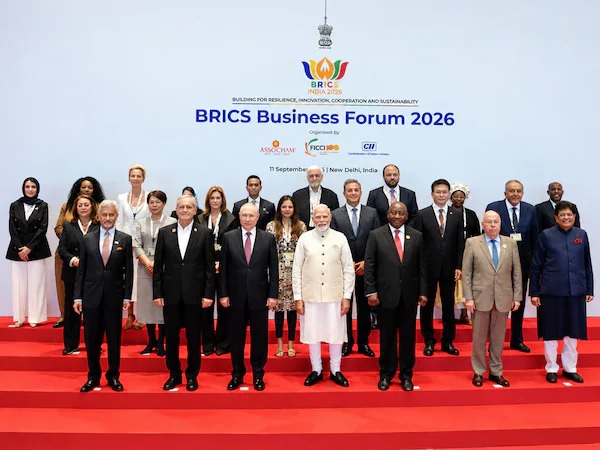
PM Narendra Modi with Russian President Vladimir Putin, Chinese President Xi Jinping, Indonesian President Prabowo Subianto, and Egyptian President Abdel Fattah el-Sisi in New Delhi at the BRICS summit. PTI
The 18th BRICS Summit, marking two decades of the group’s formulation, concluded on September 12-13. The summit, hosted by India, brought together the heads of states of all 11 member nations, providing an opportunity for both multilateral deliberations and significant bilateral engagements. It also tested the effectiveness of an expanded and increasingly diverse BRICS, questioning whether and to what extent consensus could be formulated.
The New Delhi Declaration emerged as a pivotal document, reflecting a delicate balance among the member states. By adopting a 140-point declaration that avoided direct blame, BRICS demonstrated its commitment to unity despite differing perspectives on global issues. This approach not only reinforced the group’s cohesion but also set a precedent for future discussions.
Two elements stand out from India’s 2026 BRICS presidency: the New Delhi Declaration and the diplomatic activity on the sidelines of the summit. The declaration also endorsed China as the 2027 chair.
For India, an important outcome was the reference to the April 2025 terror attack in Pahalgam. Unlike the Rio Declaration last year, the New Delhi Declaration explicitly condemned the attack: “We condemn in the strongest terms the terrorist attack in Jammu and Kashmir on 22 April 2025, during which 26 people were killed and many more injured.”
It also addressed the continuing conflict in West Asia. With Iran and the UAE now both BRICS members and directly affected by the conflict, the text expressed concern over the escalation of tensions, without naming any parties, yet reaffirming the UN Charter and calling for exercising maximum restraint. The Rio Summit had also addressed the situation in West Asia, but none of the countries directly involved in the conflict were BRICS members at the time.
At the bilateral level, the summit provided an important platform to engage key partners. Most notably, the meeting between Prime Minister Narendra Modi and Chinese President Xi Jinping signaled continued efforts to stabilize India-China ties, following the 2020 Galwan Valley clash leading to severe deterioration in the relationship.
The two sides discussed areas of cooperation, including trade, business links, supply chains, and people-to-people exchanges, while also reiterating that peace and tranquility along the border remain essential to the development of bilateral ties. The statements from the two sides, however, differed in emphasis and tone.
India also sought to address a larger problem within BRICS—the tendency for initiatives launched during one presidency to lose momentum under the next. PM Modi proposed the BRICS Continuity and Implementation Mechanism, under which the troika (outgoing, current, and incoming chairs) will track progress and systematically follow up on outcomes. The proposal’s real test will come after the handover to China for the 2027 chairship.
India’s chairship also tried to move BRICS beyond leader-level statements and towards mechanisms with a more direct impact on trade, investment, and businesses. This included advancing the BRICS Economic Partnership 2030 and working on development finance, infrastructure, and investment. The practical significance of these initiatives, however, should not be overstated. Several proposals, including the investment platform, remain under development.
There are three important differences between India’s 2021 and 2026 presidencies of the BRICS. First, the composition of the grouping has changed substantially. In 2021, the group comprised only the five original members, whereas in 2026 it has expanded to 11 members and 10 partner countries. This has increased the group’s economic weight but made consensus more difficult.
Second, the two presidencies took place in very different contexts. The 2021 Summit was held virtually following the outbreak of the Covid-19 pandemic and against the backdrop of the India-China border standoff. In 2026, India was able to host an extensive program of over 350 meetings across 30 Indian cities. Substantively, the 2021 Summit New Delhi Declaration focused on global health challenges and combating the pandemic, particularly focusing on vaccine production and distribution.
In 2026, however, India placed greater emphasis on science and technology, agroecology, fintech, and economic cooperation, alongside its continued push for UN and multilateral reform around representation, responsiveness, and rulemaking.
Third, the economic relationship within BRICS has deepened. Indian trade with BRICS members has more than doubled from $203 billion in 2020-2021 to $417 billion in 2025-2026.
Recognizing this expanded potential for intra-bloc trade and market opportunities in these developing economies, the group emphasized customs cooperation, trade finance, supply chains, and digital payments while also addressing trade asymmetries.
While efforts to boost intra-bloc trade and streamline payment mechanisms have expanded, BRICS does not yet have an operational system for cross-border trade in national currencies.
The BRICS Payment Task Force will continue to explore practical solutions for efficient cross-border payments and enhancing interoperability of payment and messaging channels. This builds on the BRICS Cross-Border Payments Initiative referenced in the Kazan and Rio Declarations.
India pushed for a more ambitious approach, including linking the fast-payment systems of BRICS countries and examining interoperability between central-bank digital currencies. The objective is to make payments faster, cheaper, and more reliable. Implementation is complicated by the fact that members have different exchange rate regimes, capital controls, exposure to sanctions, banking regulations, and payment standards. Intra-BRICS trade is also highly asymmetric, with China’s dominance accounting for a substantial share and several members running large trade deficits with it.
The discussions on trade in national currencies also help distinguish what BRICS is realistically pursuing from the often-repeated misconception of a common BRICS currency. Still, the members have not agreed on a common technical architecture, a shared settlement mechanism, or the launch of the payments platform, BRICS Pay, to materialize trade in national currencies beyond the existing initiatives at bilateral levels.
India’s attempt was to keep the group focused on its core concerns of development, trade and practical cooperation in technology, while securing meaningful language on conflicts despite a fragmented geopolitical environment. It is now increasingly necessary for these ambitious efforts to witness materialize — such as on payment systems interoperability, MSME financing, greater investment announcements, and meaningful bilateral development under future presidencies.
A notable highlight was the bilateral engagement between Prime Minister Narendra Modi and Chinese President Xi Jinping. This meeting underscored the importance of stabilizing India-China relations, particularly in light of past tensions. Their discussions on trade and cooperation signal a willingness to move forward, emphasizing the need for peace along their shared border.
India’s presidency also sought to address the continuity of initiatives within BRICS. The proposed Continuity and Implementation Mechanism aims to ensure that progress is tracked and sustained across presidencies, a crucial step in maintaining momentum for collaborative projects.
In contrast to India’s previous chairmanship in 2021, the 2026 presidency faced a vastly different landscape. The expansion of BRICS to include 11 members and 10 partner countries has not only increased its economic clout but also complicated consensus-building. The focus has shifted from pandemic-related issues to broader themes such as science, technology, and economic cooperation, reflecting the evolving priorities of member nations.
The Global South grouping was initiated in 2006 by Brazil, Russia, India and China (BRIC). After South Africa joined the grouping four years later, it acquired its current name BRICS. The bloc has since expanded to include Egypt, Ethiopia, Iran, the United Arab Emirates, Saudi Arabia, and Indonesia.
The BRICS nations constitute nearly half the world’s population and account for approximately 40 percent of global gross domestic product (GDP).
The bloc has sought greater influence for developing economies in institutions traditionally dominated by Western powers and has pushed for reforms to bodies, including the World Bank, the International Monetary Fund and the World Trade Organization.
Conveying India’s position, Modi insisted that the bloc should not be interpreted simply as an anti-Western project.
“BRICS is not against anyone,” he said, while arguing that the Global South should play a bigger role in shaping global governance.
The war was one of the biggest tests of whether the expanded BRICS could reach a common position.
Leaders expressed “deep concern over the continued escalation of tensions” in the Middle East and called for “maximum restraint,” while urging countries to avoid actions that could further aggravate the situation. It did not mention the US, Israel, Iran or the Gulf states explicitly.
The joint statement issued at the BRICS Summit in Rio de Janeiro last year had condemned the US and Israeli war on Iran, calling it a “blatant breach of international law”.
China’s Xi said in a statement the war “does not serve the common interests of the international community”, and called for a political settlement and a permanent and comprehensive ceasefire.
In May, BRICS foreign ministers failed to agree on a joint statement amid differences over the war. Iran is a member of BRICS, as is the UAE, which has faced Iranian attacks during the conflict.
Former Indian Foreign Secretary Nirupama Menon Rao said New Delhi scored a “significant diplomatic success” in securing a declaration despite “sharp differences between Iran and the UAE.”
“Consensus was preserved, but only through carefully generalized language. In this, BRICS’s value and its limitation were exposed: it can keep difficult conversations alive and affirm broad principles, but it struggles to assign responsibility or organize collective action when there is the occasional collision of the interests of its members,” she posted on X.
The declaration also raised concern over deliberate attacks on civilian infrastructure and peaceful nuclear facilities protected by International Atomic Energy Agency (IAEA) safeguards—language that could be seen as an indirect criticism of US and Israeli attacks on Iranian nuclear sites.
During the 12-day war in 2025, the US bombed three main Iranian nuclear facilities at Natanz, Isfahan, and Fordow.
Praveen Donthi, senior analyst at the International Crisis Group, said expectations for the BRICS summit were low due to geopolitical turbulence and clashing strategic interests.
“The members, invested in the success of this non-Western grouping, would be reasonably satisfied with the modest outcome,” he said.
Donthi added that India used its strong ties with all members and worked behind the scenes to release the declaration, overcoming the biggest hurdle: convincing the UAE and Iran, who are on opposite sides of the ongoing conflict.
The Ukraine war remains another source of tension within BRICS, particularly because Russia is a founding member of the group.
The declaration issued a generic call for international disputes to be resolved through “dialogue, consultation, and diplomacy” without mentioning Ukraine.
However, BRICS leaders criticized unilateral sanctions not authorized by the United Nations Security Council.
“We call for the elimination of such unlawful measures, which undermine international law and the principles and purposes of the UN Charter,” the statement said.
The position is significant for Russia, which has faced extensive Western sanctions since its full-scale invasion of Ukraine in 2022. India, meanwhile, has maintained close relations with Moscow, importing oil from Russia amid disruption to global oil supplies since the US-Israel war on Iran broke out.
Kremlin spokesman Dmitry Peskov said on Sunday that Xi and Modi offered their services for peace talks on Ukraine, and that Putin welcomed their readiness, state news agency TASS reported.
Last year, Trump imposed a 25 percent tariff on Indian goods as a penalty for its purchase of Russian crude. India has since cut down its imports of Russian crude oil.
BRICS adopted much more explicit language on Palestine.
The declaration expressed “firm opposition” to the forced displacement of Palestinians and to attempts to change the geography or demography of the occupied Palestinian territory.
It called for an end to Israel’s genocidal war on Gaza, unhindered humanitarian access, support for UNRWA, the UN agency for Palestinian refugees, and full UN membership for Palestine.
The bloc also reiterated its support for a two-state solution and the establishment of a sovereign Palestinian state based on the 1967 borders, with occupied East Jerusalem as its capital.
The declaration raised concern over “unilateral tariff and non-tariff measures” that distort trade, while also opposing sanctions imposed without UNSC authorization.
Washington has imposed tariffs on several BRICS countries, including China, Russia, and India, and President Donald Trump has previously described the grouping as “anti-American.” He threatened additional tariffs against countries aligning themselves with it.
Speaking at the summit, Putin accused countries “accustomed to thinking in colonial categories” of using tariffs, sanctions, and “brute force” to contain emerging competitors.
At the same time, the bloc called for cooperation to protect global trade, supply chains, energy flows, and maritime security as wars disrupt international commerce.
BRICS reiterated its “commitment to strengthening multilateralism and multipolarity,” noting that a multipolar world can expand opportunities for Emerging Markets and Developing Countries (EMDCs) to develop “constructive potential and enjoy universally beneficial, inclusive, sustainable, and equitable economic globalization and cooperation.”
Putin called for greater representation for Asia, Africa, and Latin America on the UNSC and argued that the shift towards a multipolar world was being resisted by established powers.
Xi said BRICS countries should help steer the international order towards greater “equity and justice,” while Modi called for the Global South to move from being a rule-taker to a “rule-shaper.”
“We have to transform this pyramid of privilege into a platform of partnership,” Modi told the summit.
Yet India has also sought to distance BRICS from the idea that it exists simply to confront the West. “We are not against anyone; rather, we strive to move forward with the approach of taking everyone along,” he asserted.
As BRICS looks to enhance intra-bloc trade, the discussions surrounding cross-border payment systems are particularly noteworthy. While the group has yet to establish a fully operational system for trade in national currencies, the ongoing efforts to improve payment mechanisms signal a commitment to facilitating smoother transactions among member states.
In conclusion, the 2026 BRICS Summit has set the stage for a more integrated and cooperative future. As the group navigates the complexities of international relations, the emphasis on dialogue, economic collaboration, and conflict resolution will be crucial in shaping its trajectory in the years to come.