Mir Mahmud Ali
For over nine years, more than 1.2 million Rohingya people, displaced from their homeland, have been living in subhuman conditions in refugee camps in Cox’s Bazar. The historic ruling by the International Court of Justice (ICJ) and a recent resolution adopted by an overwhelming majority in the UN General Assembly have breathed new life into the Rohingya people’s long-held aspirations for justice and their dream of returning to their own country. However, these legal and diplomatic victories will only be meaningful if a safe environment is established in Myanmar’s Rakhine State, ensuring their dignified repatriation.
Outpouring of Emotion and International Validation
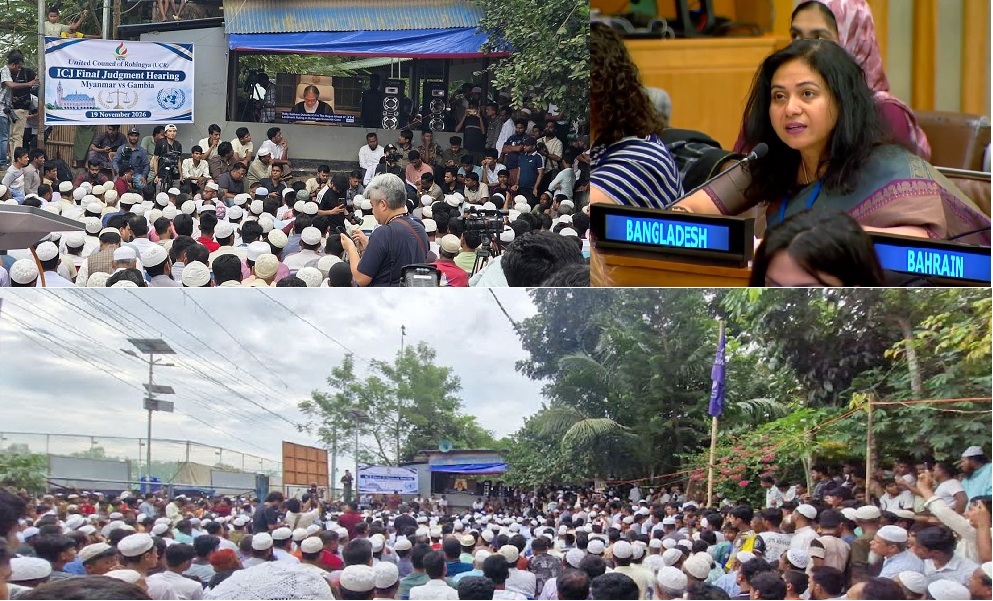
The relief witnessed across the camps of Ukhia and Teknaf following the ICJ’s ruling in The Gambia v. Myanmar—delivered in The Hague on Thursday (November 19, 2026)—reflects the long-standing anticipation of an oppressed people. In Kutupalong, the emotional reaction was immediate and profound. For a community that has endured systematic erasure, residents view the court’s decision as vital international validation of the brutal atrocities inflicted upon them. Combined with the UN General Assembly’s recent resolution on Rohingya human rights—backed by 128 nations—these milestones prove that the global conscience remains alert to their plight.
Hope Tempered by Hard-Earned Realism
Yet, in the quiet corners of the camps, hope is heavily tempered by hard-earned realism. Legal victories in distant courtrooms and diplomatic consensus in New York, while morally significant, do not automatically build safe villages in Rakhine State. A gavel in The Hague cannot clear landmines, dismantle discriminatory laws, or guarantee a peaceful night’s sleep back home.
The Heavy Toll on Bangladesh
Meanwhile, the weight of this protracted crisis continues to press heavily on Bangladesh. As Bangladesh’s Chargé d’Affaires to the UN, Sanchita Haque, recently underscored, hosting over a million refugees for nearly a decade has exacted a severe social, economic, environmental, and security toll on the country and its local communities. Bangladesh’s humanitarian generosity has been extraordinary, but no single nation can—or should—be expected to shoulder a global responsibility indefinitely.
Addressing the Root Causes Inside Myanmar
Turning the Rohingya’s dream of repatriation into a sustainable reality requires moving beyond symbolic declarations to address the root causes inside Myanmar:
• Halting Violence and Ensuring Accountability: The recent UN resolution rightly draws attention to ongoing abuses committed by both the Myanmar military and the Arakan Army. Repatriation is impossible while Rakhine State remains an active conflict zone. Peace must be restored, and perpetrators of atrocities must face genuine accountability.
• Restoring Citizenship and Dignity: The Rohingya have made it clear they will not trade open-air refugee camps in Bangladesh for fenced-in detention centers in Myanmar. Safe return means the full restoration of their citizenship, voting rights, and freedom of movement. Without legal recognition, they remain vulnerable to the very persecution that drove them out.
• Sustained Global Action Over Rhetoric: While major powers, including the United States, frequently praise Bangladesh for sheltering the Rohingya, diplomatic applause is not a strategy. The international community must fully fund humanitarian lifelines like the 2026 Joint Response Plan while applying coordinated, tangible diplomatic pressure on Myanmar to create conditions conducive to return.
A Permanent Solution Lies Within Myanmar
The Rohingya crisis began in Myanmar, and its permanent solution lies within Myanmar’s borders. The ICJ ruling and the UN resolution have provided the international community with powerful legal and moral leverage. If global powers choose to use that leverage with real resolve, the dream of a safe, dignified return—kept alive for nearly a decade in the hills of Cox’s Bazar—may finally move within reach.
Writer: CEO, Mass Information Research