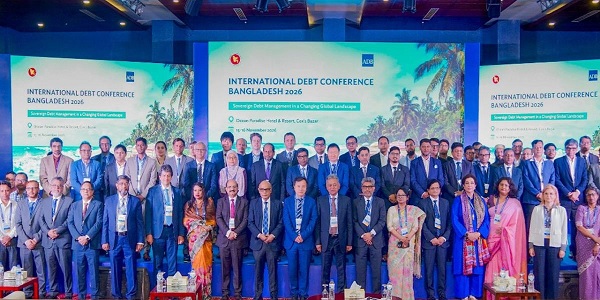
Economy Desk: The government has set a target to elevate Bangladesh into a one-trillion-dollar economy by 2034. To achieve this, Finance and Planning Minister Amir Khasru Mahmud Chowdhury has emphasized the importance of prudent borrowing, budgetary discipline, and sustainable financing.
He made these remarks on Sunday (November 15) during the inaugural session of the two-day ‘International Debt Conference Bangladesh 2026’ held in Cox’s Bazar.
The Finance Minister noted that the growing burden of principal and interest repayments, weaknesses in revenue collection, and limited fiscal space for budgetary expenditure pose significant challenges to the nation’s economy.
He stated, “Our objective must be to ensure that every taka borrowed contributes meaningfully to economic growth, productivity, and public welfare.”
Amir Khasru Mahmud Chowdhury further added that the government aims to access international capital markets while securing funds in a responsible and sustainable manner.
The Finance Minister mentioned that the government is exploring new financing avenues, including sovereign Sukuk, green and blue bonds, and blended finance. He remarked, “When evaluating the success of government borrowing, the effectiveness with which the funds are utilized for economic growth, public welfare, and long-term prosperity is far more important than the total volume of debt.”
The conference, held on November 15 and 16, is jointly organized by the Finance Division of the Ministry of Finance and the Asian Development Bank (ADB). The theme for this year’s event is ‘Sovereign Debt Management in a Changing Global Context.’
Policymakers, government officials, and finance experts—both domestic and international—have gathered at the conference to discuss how to pursue sustainable borrowing amidst rising financing costs, global economic uncertainty, and shifts in international capital markets. Participants include representatives from the Finance Division, the Economic Relations Division, the Internal Resources Division, the Financial Institutions Division, the National Board of Revenue, and the Bangladesh Bank. Officials from the debt management offices of Sri Lanka, Pakistan, Indonesia, and Malaysia, as well as representatives from the Asian Development Bank (ADB), the World Bank, and the International Monetary Fund (IMF), are participating.
The inaugural session was chaired by Finance Secretary Dr. Md. Khairuzzaman Majumder. Speakers included Tanvir Shahriar Ghani, Special Assistant to the Prime Minister; Nazma Mobarek, Secretary of the Financial Institutions Division; and Cingfeng Zhang, Country Director of the ADB’s Bangladesh Resident Mission. Hasan Khaled Faisal, Additional Secretary of the Finance Division, outlined the conference’s theme, while S. M. Ebadur Rahman, Senior Social Sector Officer at the ADB’s Bangladesh Resident Mission, delivered the welcome remarks.
Tanvir Shahriar Ghani suggested that, while carefully assessing its debt-servicing capacity, Bangladesh should explore the possibility of raising funds through dollar-denominated Eurobonds and Sukuk. He noted that if Bangladesh were included in a J.P. Morgan index for emerging market government bonds, the country’s government securities could gain greater visibility among international investors. According to him, attracting foreign investment requires strengthening the economic foundation, ensuring transparency in transactions, and establishing reliable mechanisms for the repatriation of investment returns.
Ghani also emphasized the need to enhance the country’s integration with international transaction settlement systems to finance large-scale industrial projects, and to strengthen the synergy between the banking sector and the capital market.
Finance Secretary Dr. Md. Khairuzzaman Majumder stated that, as part of preparations for graduating from the Least Developed Country (LDC) category, the Finance Division is working to publish an annual debt plan. This initiative aims to increase transparency in government financing and provide advance guidance on the timing and scale of government borrowing.
The Finance Secretary further noted that government borrowing has become increasingly complex due to fluctuations in global interest rates and currency exchange rates. He also outlined plans to improve reporting on domestic and external debt—including the repayment of principal and interest—strengthen the auction mechanism for treasury bills and bonds, and attract a broader range of investors to the market.
Nazma Mobarek noted that, in terms of local currency, annual interest payments on external debt are projected to more than double between the 2024–25 and 2028–29 fiscal years. By the end of the 2024–25 fiscal year, total government debt stood at less than 39 percent of the Gross Domestic Product (GDP), a ratio expected to remain relatively stable through the 2028–29 fiscal year.
Qingfeng Zhang of the Asian Development Bank (ADB) pointed out that rising debt-servicing costs are narrowing the fiscal space available for development expenditure in Bangladesh, while reliance on domestic borrowing continues to grow. Total expenditure on the repayment of debt principal and interest rose from 2.3 percent of GDP in the 2020–21 fiscal year to 3 percent in 2024–25.
Zhang urged for the disclosure of more comprehensive data on government debt—including information on state guarantees—and called for better coordination between debt management, cash management, and budget planning. To mitigate budgetary risks, he recommended expanding the domestic bond market, strengthening project evaluation and public procurement processes, and enhancing oversight of state-owned enterprises and public-private partnership (PPP) projects.
Developing nations are engaging in these discussions at a time when decisions regarding the financing of public investment, debt repayment, and the maintenance of budgetary stability are becoming increasingly complex. A key focus of the conference will be how to effectively utilize debt to drive infrastructure development, job creation, and economic growth, while avoiding unsustainable pressure on the national budget.
Prasad Ananthakrishnan, an ADB consultant and former IMF advisor, highlighted the relationship between government borrowing, productive investment, and economic growth in a special address. He explained the circumstances under which public debt can benefit an economy, as well as when excessive borrowing undermines budgetary stability or crowds out private investment.
The implications for countries transitioning out of Least Developed Country (LDC) status will also be a key focus of the discussion. Particular emphasis will be placed on diversifying funding sources and expanding opportunities to raise capital from international financial markets.